A Body Written In the Edo Night
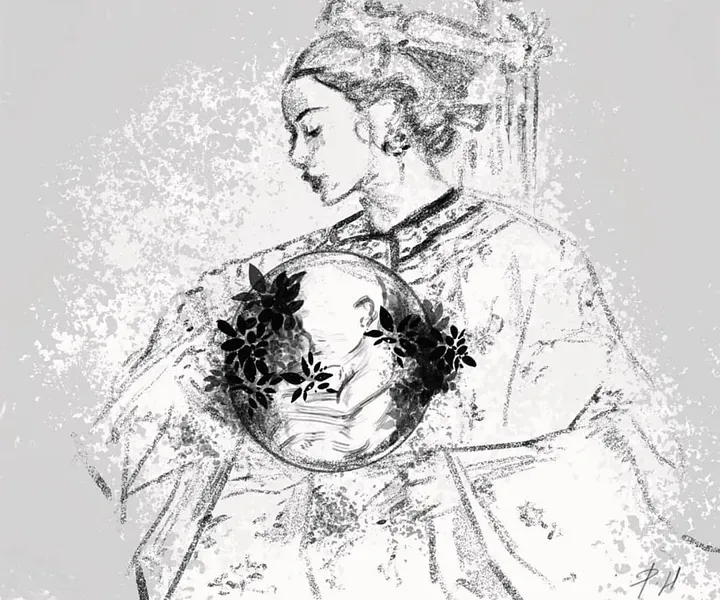
She desired a daughter more than anything in the world. She had been alone for many years, surrounded only by empty sheets and black ink. Her small house stood at the edge of a forest, its wooden walls darkened by rain, a single oil lamp breathing smoke into the night.
Whispers from the village carried through the trees. They said she was an unfit woman, one who defied her place. A wife without a husband, a mother without a child. They said strange things always happened around her, so it was better not to read what she wrote.
One day, she composed:
Buddha’s Birthday
on this day is born
a baby deer.
That same night, she dreamed of giving birth. A twisted being came from her body, with the legs of a fawn and human arms. It cried for her, calling her mother, asking for milk. She stepped back slowly, but it crawled toward her. She had to take responsibility. There was no choice. She seized the nearest object and crushed it, striking again and again.
The next evening, when neither stars nor moon could be seen, she heard a sound she recognized, one that made her whole body shiver. It came from the deepest part of the forest. She followed until the trees thinned and found the creature, precisely as in her dream, half crushed into the earth. She fled home, shaking.
She wrote again, her hand moving without will:
My dwelling lies
within my mother’s dream
still inhabited.
Ink spread across the tatami like veins. The baby was there again, feeding from her body, consuming not only milk but flesh, growing with impossible speed until it became a new woman.
By dawn, in that house of cedar and paper, the woman stood quietly, longing for a daughter.
Author’s Note
The first haiku is originally by Matsuo Bashō (1644–1694). Although written in the late seventeenth century, his work profoundly influenced the poetry of the eighteenth. I found it interesting to include an existing verse, especially since I consider myself an artist of prose rather than poetry.
The second haiku belongs to Kaga no Chiyo, also known as Chiyo-ni, who lived between 1703 and 1775 during the Edo period. She is remembered as one of Japan’s greatest haiku poets, and her sensitivity toward nature and solitude resonated deeply with the tone I wanted to capture here.
The story itself was inspired by one of my own paintings from years ago. Revisiting that image through words allowed me to reimagine it within the quiet horror of the Edo world.
The most difficult part was trying to convey the feeling of that era within so few words. I would have loved to describe more, but those exact 300 words felt like both a limit and a challenge.
Published in the Dark Lore Digest
For readers who crave mystery, thrill, and otherworldly adventures, our pages are filled with the uncanny, the macabre, and the extraordinary.