Can a Robot Be a Mother? Exploring The Wild Robot and Posthuman Care
Introduction
What does it mean to be a mother? And could a robot ever embody that role?
This essay will discuss a possible posthumanist future for machines, in which they are not only independent but also possess consciousness and can be integrated into human society — for example, in parental roles.
The goal is not to provoke fear about robots replacing humans, but to imagine what advanced intelligent machines would require in order to provide love and care to children who are abandoned or unprotected.
Read the full academic paper here.
What It Means to Be a Mother
Being a mother can refer to the biological act of a human giving birth to a baby, or, in a more modern and precise sense, as defined by the Cambridge Dictionary:
“Female parent.” If we then look at the definition of parent in the same dictionary, it is described as: “a mother or father of a person or an animal, or someone who looks after a person in the same way that a parent does” .
According to UNICEF (the United Nations organization for children), “parenting is the job of providing nurturing care throughout childhood, preparing children to live in society, form relationships, learn, work and thrive” (UNICEF, About UNICEF Parenting, n.d.).
Yet not all mothers feel the same connection. Postpartum depression, lack of attachment, or cultural pressures can complicate the maternal bond. Being a mother is therefore not a universal experience, but a diverse and often challenging role.
What It Means to Be a Robot
If we think of a robot in basic terms, we could say, as the Cambridge Dictionary puts it: “a machine controlled by a computer that is used to perform jobs automatically.”
Technology continues to advance by giving robots the ability to do more than just solve one problem at a time for which they were programmed. In science fiction, we often encounter robots that are imagined as capable of breaking free from this programming — either to rebel against it or to live despite having a mechanical body, as in the case of the replicants in Blade Runner.
In a posthumanist framework, the definition of a robot expands even further. If humans integrate technology into their own bodies, and machines evolve toward autonomy and consciousness, the distinction between “human” and “robot” may eventually dissolve. In this framework, a robot could also embody social roles once thought to be uniquely human.
Can a Robot Be a Mother? Lessons from The Wild Robot
Peter Brown’s The Wild Robot offers a literary exploration of this question. The story follows Roz, a robot who finds herself stranded on a wild island. Initially seen as strange and threatening, Roz gradually learns from nature and the animals around her. When she takes responsibility for an orphaned gosling, she becomes his mother. Through trial, error, and empathy, Roz embodies the qualities of care, protection, and love.
The key difference is the humanity with which Roz, the robot, is described from the very beginning: “Like a hatchling breaking from shell, Roz climbed out into the world” (Brown, 2016, p. 8). She is portrayed as a small and vulnerable creature, curious (Brown, 2016, p. 8), struggling to survive and learning by mirroring the behavior of animals (Brown, 2016, p. 14)
From these descriptions, it seems natural to expect that Roz is capable of becoming a mother, going through what could be seen as a human life cycle — being born, growing, loving, aging, dying. All of this is experienced by the robot. The differences between Roz and humans are only in how we call her a robot and in her physical construction and appearance. But in terms of emotions, humanness, vitality, and animality, everything is there, just as in us.
And no animal could have a more attentive mother than this robot, who can care for him day and night (Brown, 2016, p. 99). As the author describes, “the gosling felt loved” (Brown, 2016, p. 90).
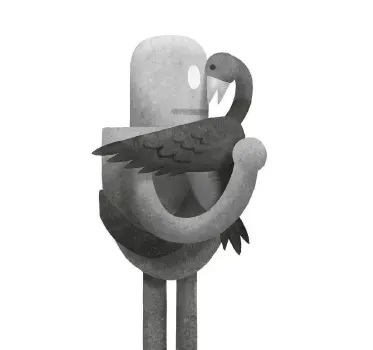
Roz, a robot, gently cradles with her son Brightbill, a gosling. Their tender embrace highlights the emotional bond between the robot and the young goose. (Brown, The Wild Robot, 2016)
Arguments Against Robotic Motherhood
Critics highlight several concerns:
- Lack of human vulnerability: A robot cannot share the lived experiences of illness, trauma, or mortality in the same way a human mother does.
- Risk of dehumanized care: Overreliance on machines may reduce the deeply human elements of caregiving.
- Socialization challenges: A child raised by a robot might struggle to connect with other humans.
- Fear of autonomy: Popular culture (e.g., Terminator, Blade Runner) often portrays conscious machines as threats rather than caregivers.
Arguments For
On the other hand, there are compelling reasons to imagine robots as caregivers:
Robots can provide uninterrupted care, day and night, without fatigue. With sensors, emotional recognition, and adaptive learning, they can respond to children’s needs in real time. A child’s sense of being cared for may depend more on consistent nurturing behaviors than on the caregiver’s biology. Literature like The Wild Robot shows how even fictional machines can embody empathy and responsibility, challenging our assumptions of what caregiving means.
Conclusion
This article is not intended to be provocative by suggesting that robots should replace humans. Rather, it seeks to explore what an advanced intelligent robot would require in order to provide love and care to children who are abandoned or not properly protected. It is about envisioning a society perhaps far removed from our present, in which robots have been integrated not merely as machines of automation, but as beings that also possess consciousness and can take on roles that some humans cannot or do not wish to fulfill.
That, one could argue, is what true progress would mean.
This essay was published in Women Write Publication.
Women Write is a space where stories, thoughts and voices are welcomed. A community by women, for women, open to all. Voices unfiltered, words unbound. No judgements, only support. A place for all stories, told, untold, sad, messy, happy, finished, unfinished, good and bad.